
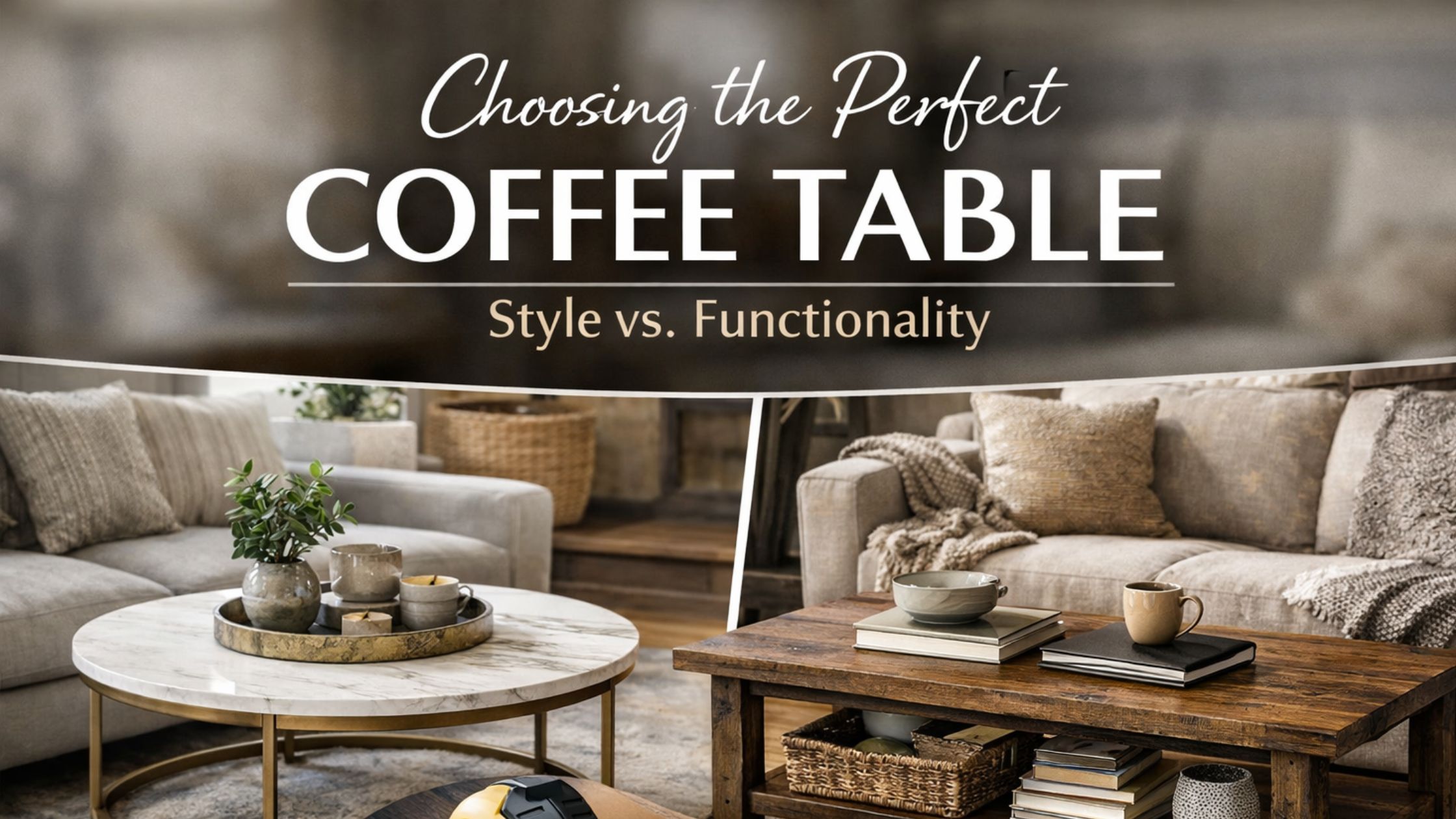
The coffee table sits right at the heart of your living room. It’s the first thing guests notice, the surface your kids pile books on, and the piece that ties your whole seating arrangement together. And yet, most people spend surprisingly little time choosing one.
A lot of homeowners in Dubai rush this decision — they pick whatever looks good in the showroom or matches the sofa color. But a few months later, the table feels too big, too low, too fragile, or just wrong for how they actually live. Choosing the right coffee table means thinking about both how it looks and how it works in your daily life.
This guide walks you through everything: shapes, sizes, materials, storage, placement, and how to find the balance between a table that’s beautiful and one that actually does its job.
Why the Coffee Table Matters More Than You Think
Most people focus their interior design budget on sofas, curtains, and lighting. The coffee table gets treated like an afterthought. But here’s the thing — the coffee table is central to how your living room functions.
It holds your morning coffee, your remote controls, your kids’ homework, your books, your decorative tray. It’s where guests rest their drinks during dinner parties. It defines the flow of movement around your seating area. A wrong-sized table makes a spacious room feel cramped. A poorly built one becomes a liability the moment someone sets a heavy vase on it.
In short: get this piece right, and everything else in the room falls into place.
Style First — What Look Are You Going For?
Before anything else, think about the visual direction of your living room. Your coffee table should feel like it belongs — not like it was borrowed from another room.
Modern and Minimalist
Clean lines, flat surfaces, and simple geometry. Think rectangular tables with slim metal legs, glass tops, or matte-finished wood. If your living room has a neutral palette — whites, greys, beiges — a minimalist coffee table keeps things calm and uncluttered.
Materials like tempered glass, brushed steel, or light oak work well here. Avoid heavy ornamentation or carved details — they’ll clash with the simplicity of the space.
Classic and Traditional
If your living room leans toward rich fabrics, warm wood tones, and detailed molding, a traditional coffee table fits right in. Round or oval shapes with turned legs, dark walnut finishes, or antique brass accents are classic choices.
These tables tend to feel warmer and more formal. They’re a good match for spaces with heavy curtains, patterned rugs, and classic upholstered sofas.
Contemporary Luxury
This is where things get interesting — especially in a city like Dubai, where interior design often blends global trends with local taste for richness and detail. Contemporary luxury coffee tables sit somewhere between modern and traditional. They’re refined but not cold. Think marble tops with gold-finished bases, custom lacquered finishes, or hand-crafted wood with subtle inlays.
If this is the direction you’re going, a custom coffee table from Casabella Interiors gives you control over every design decision — material, size, finish, base style — so the piece fits your room perfectly, not just approximately.
Industrial and Urban
Exposed metal, reclaimed wood, and raw finishes. This style works well in loft-style apartments or spaces with high ceilings and concrete elements. Coffee tables in this category often feature welded steel frames, dark iron legs, and distressed wood tops. They’re rugged, unpretentious, and surprisingly versatile.
Functionality Next — How Will You Actually Use It?
Style is important, but a coffee table that doesn’t work for your life gets annoying fast. Think about your daily routines before you commit to any design.
Do You Have Kids?
If you have young children at home, sharp corners are a real concern. Round or oval coffee tables are much safer. You’ll also want a surface that’s easy to wipe clean — sealed wood, lacquered finishes, or tempered glass tend to handle spills better than raw stone or unsealed timber.
And honestly, you probably don’t want to spend a fortune on something delicate when it’s going to be used as a fort, a drawing surface, and a launching pad for toy cars.
Do You Use It for Eating and Working?
A lot of people in Dubai — especially in apartments — end up using the coffee table for casual meals or working from home on the couch. In that case, height matters. Standard coffee table height is around 40–45 cm, which works fine for drinks and decor. But if you’re eating or working there regularly, a lift-top coffee table (where the surface raises to a more comfortable working height) is worth considering.
Nesting tables are another option — smaller tables that tuck under the main one and pull out when you need extra surface space.
Do You Need Storage?
Most living rooms in Dubai apartments aren’t short on style — they’re short on storage. A coffee table with built-in shelves, drawers, or a lift-up compartment can do double duty. You can store extra cushions, remote controls, kids’ toys, or books without adding another piece of furniture to the room.
Ottoman coffee tables — upholstered cubes or rectangular poufs with a flat, stable surface — also serve as seating when you need extra places for guests. They’re practical and they soften the look of the room at the same time.
Getting the Size Right
This is where most people go wrong. They pick a table based on looks and then realize it doesn’t scale properly with the sofa or the room.
Length and Width
A general rule: the coffee table should be about two-thirds the length of your sofa. So if your sofa is 240 cm wide, the coffee table should be roughly 150–160 cm long. Going too short makes the table look lost. Going too long makes it hard to move around.
For sectional sofas, a round or square table often works better than a long rectangular one — it lets people on both sides of the sofa reach it comfortably.
Height
The table should sit at roughly the same height as your sofa cushions — or within 5 cm. Too low and you’re bending awkwardly every time you set something down. Too high and it looks visually heavy.
Clearance
Leave at least 45 cm between the coffee table and the sofa. That’s enough space to walk past, sit down, and reach forward without knocking into anything. If your room is smaller, go for a slimmer table rather than cramping the walkway.
Choosing the Right Material
The material you choose affects both look and durability. Here’s a straightforward breakdown:
Solid Wood — Warm, durable, and timeless. It scratches, but scratches can be sanded and refinished. A good solid wood table can last decades. Works in almost any interior style.
Marble — Visually stunning, especially in Dubai’s contemporary luxury interiors. It’s heavy, which makes it stable, but it can chip and stain if not sealed and maintained. Not ideal for households with very young children.
Glass — Makes small rooms feel larger. Easy to clean. But it shows fingerprints constantly and can feel cold in a warm, cozy interior. Tempered glass is much safer than standard glass.
Metal — Usually seen in the frame rather than the top surface. Powder-coated or brushed metal frames are durable and suit both industrial and contemporary styles.
MDF and Engineered Wood — Common in mid-range furniture. Not as durable as solid wood but lighter and less expensive. Fine for lower-traffic settings, but watch out for swelling in humid environments if the finish isn’t good quality.
Rattan and Cane — Trending heavily right now. Lightweight, casual, and works beautifully in boho or coastal interiors. Not ideal as a primary family table but lovely as a secondary accent piece.
If you’re investing in a statement piece, solid wood or marble with a custom finish gives you the best combination of longevity and visual impact. Casabella Interiors specializes in custom furniture in Dubai built to exacting standards — which means you get the material quality and craftsmanship that cheap flat-pack furniture simply can’t match.
Shape: Round, Rectangular, Square, or Oval?
Rectangular — The most common shape. Works well with standard straight sofas. Easy to scale — you can find rectangular tables in almost any size.
Round — Softer visually. No sharp corners, making it safer for families. Works well with sectional sofas or in smaller rooms where a rectangular table would dominate.
Square — Great for square seating arrangements or rooms where you want a more balanced, symmetrical look. Pairs well with modular sofas.
Oval — Combines the practicality of a rectangular table with the softer edge of a round one. A good middle-ground choice, especially for rooms with curved furniture.
There’s no universally correct answer. It comes down to your room layout, sofa shape, and personal preference.
Coffee Table Styling — Making It Look Intentional
Even the best coffee table can look like an afterthought if it’s not styled well. A few simple principles help:
Group in odd numbers. A set of three objects — a candle, a small plant, and a decorative tray — tends to look more natural than two items or four.
Vary the height. Mix tall and short objects so the arrangement has some visual movement.
Use a tray. A tray corrals smaller objects and instantly makes a coffee table look organized. It also makes it easier to clear the surface quickly when you need the space.
Leave some surface empty. You need room to actually put your cup down. A coffee table that’s completely covered in decor is no longer functional — it’s just a display shelf at a bad height.
Connect to the room. Pull colors and materials from the rest of the space. If your sofa has blue cushions, a small blue vase on the coffee table ties things together without feeling forced.
How a Custom Coffee Table Changes the Equation
Ready-made coffee tables come in standard sizes, standard materials, and standard finishes. That works for a lot of people. But if you’ve got a specific room size, a particular design direction, or you just want something that feels genuinely unique, custom is worth considering.
A custom coffee table is built to fit your space — not the other way around. You choose the dimensions, the surface material, the base design, the finish. If you want a white oak table with a brass hairpin base at exactly 42 cm high and 140 cm wide, you can have that. If you want a book-matched marble top with a matte black frame, that’s possible too.
And when you’re investing in a custom piece, the quality of materials and joinery matters far more than when you’re buying off-the-shelf. That’s where working with an established interior design firm makes a real difference.
About Casabella Interiors — Luxury Interior Design and Custom Furniture in Dubai
Casabella Interiors is a Dubai-based luxury interior design company. They work across residential and commercial projects, handling everything from full interior fit-outs to individual custom furniture pieces.
What sets them apart is the combination of design expertise and manufacturing capability. They don’t just specify furniture from catalogues — they design and build custom pieces that are tailored to each client’s space and taste. Whether you need a bespoke coffee table, a full living room fit-out, or a complete kitchen and wardrobe solution, they handle it under one roof.
Their custom furniture range covers everything from coffee tables and sofas to dining tables crafted to match your specific dining space and lifestyle needs. Every piece is built with attention to material quality, proportion, and finish — the kind of detail that separates furniture you love from furniture you tolerate.
If you’re planning a new home in Dubai or renovating an existing one, exploring their full custom furniture collection is a good starting point. You can work with their design team to figure out what works for your space rather than trying to adapt standard pieces to a room they weren’t designed for.
Balancing Style and Functionality — A Simple Framework
Here’s a straightforward way to think through your decision:
Step 1: Define how you use your living room. Quiet space for reading and conversations? Active family room with kids and pets? Entertainment hub for regular guests? Your use case narrows down the field significantly.
Step 2: Note your room size and sofa dimensions. From there, work out the ideal table size using the two-thirds rule for length, and aim to match the sofa cushion height.
Step 3: Decide on your style direction. Look at the rest of the room — the sofa fabric, the rug, the curtains, the floor material — and let those inform the table style rather than choosing a table in isolation.
Step 4: Choose material based on durability needs first, then aesthetics. A gorgeous marble table that’s going to stress you out every time someone sets a glass on it isn’t a good buy, no matter how beautiful it is.
Step 5: Decide between ready-made and custom. If standard sizes and materials work for you, ready-made is fine. If you have specific requirements or want something built to last and look genuinely unique, custom is worth the investment.
Final Thoughts
The coffee table is a small piece of furniture with a big job. It needs to look right, work right, and hold up over time. Getting that balance — between style and functionality — isn’t complicated, but it does require a bit of thought before you commit.
Take the time to measure your space, think about how you actually live in the room, and consider whether a custom-built piece might serve you better than whatever’s on the showroom floor. In a city like Dubai, where interiors are often thoughtfully designed and beautifully finished, your coffee table deserves the same level of attention as every other element in the room.
And if you want help getting it right, Casabella Interiors knows how to make it happen — from the first design conversation to the finished piece in your home.
Casabella Interiors — Luxury Interior Design & Custom Furniture Solutions in Dubai. Visit casabellainteriors.ae to explore their full range of interior design and custom furniture services.